How to earn all three SAQ points.
Targeted prompt below. Type your response, then submit to the AP Tutor for rubric-aligned feedback. ~12 minutes on the real exam.
The prompt
“The completion of the transcontinental railroad in 1869 transformed the United States. Goods that once took six months to reach California now arrived in a week; settlers poured westward; and previously autonomous Plains nations were brought under federal authority within a single generation.”
A. Identify ONE specific economic effect of railroad expansion in the United States between 1865 and 1898.
B. Explain ONE way that railroad expansion changed U.S. society in this period.
C. Explain ONE limitation or cost of railroad-driven expansion for a specific group.
“Champa rice, imported from Vietnam in the 11th century, transformed Song China. Two harvests a year became possible on the same land; population doubled within a century; cities of more than a million people emerged.”
A. Identify ONE specific economic development in Song China between 1200 and 1450.
B. Explain ONE way that economic development changed Song society.
C. Explain ONE limitation of economic prosperity for the Song state.
Your response
Hit Submit to grader below and your response will be scored point-by-point. You can also paste directly into the grader’s input box if you didn’t use the textarea.
What an annotated approach looks like
Part A is identification. Don’t over-think it. One specific thing, one clean sentence. “The introduction of Champa rice doubled rice yields and enabled two harvests per year.” Done.
Part B is explain how it changed something. A development → a consequence. “Doubling rice yields fed an urban population boom — cities like Hangzhou grew past 1 million, supporting a class of merchants, artisans, and a cosmopolitan urban culture that would have been impossible before.”
Part C is the trick part. What’s the LIMIT? Even great prosperity has a downside. “Despite economic strength, the Song spent enormous tribute on northern frontier defense (Liao, Jin, eventually Mongols), which strained the treasury and ultimately couldn’t prevent conquest in 1279.”
Three short paragraphs. No thesis required. No conclusion required. Just answer the question.
Practice for the 2027 non-text SAQ.
Starting May 2027, all three SAQs are required and one is built on a non-text source: a map, chart, table, or image. That question rewards a specific skill — reading data and images the way you read documents. These 12 drills train it. Work the parts on paper first, then open each key. When you want scored feedback, write your three parts and run them through the grader above.
AP World History: Modern
A traveler’s world, 1325–1354
| Region | Approximate dates | Ruler or patron |
|---|---|---|
| North Africa → Mecca (hajj) | 1325–1326 | — |
| Persia and Iraq | 1326–1327 | Il-khanate |
| East African coast (Kilwa, Mombasa) | 1331 | Swahili sultanates |
| Delhi, India (serves as qadi, an Islamic judge) | c. 1334–1341 | Sultan Muhammad ibn Tughluq |
| Maldive Islands (serves as qadi) | c. 1341–1344 | Local sultanate |
| China (Quanzhou, Hangzhou) | c. 1345–1346 | Yuan dynasty |
| Mali (Niani, on the upper Niger) | 1352–1353 | Mansa Sulayman |
Dates are approximate; drawn from the Rihla, the travel account Ibn Battuta dictated after returning to Morocco.
Source: Itinerary compiled from Ibn Battuta’s Rihla (completed c. 1355)
(a)Identify ONE pattern in Ibn Battuta’s employment shown in the table.
What earns the point
He repeatedly found work as a qadi (Islamic judge) in Muslim courts far from home — Delhi and the Maldives — showing that his legal training was employable across Dar al-Islam. Also acceptable: he moved between courts of Muslim rulers who sponsored him as a guest.
(b)Explain ONE historical development of the period 1200–1450 that made travel on this scale possible.
What earns the point
The shared institutions of the Islamic world (law, Arabic, hospitality networks like caravanserais and Sufi lodges) OR the security and infrastructure of the Mongol khanates OR mature Indian Ocean monsoon networks with established port cities. The point requires connecting the development to HOW it enabled long-distance movement.
(c)Explain ONE way accounts like Ibn Battuta’s shaped societies beyond the places he visited.
What earns the point
Travel accounts spread geographic and commercial knowledge (routes, goods, rulers’ wealth — e.g., Mali’s gold) that fed later trade and exploration; they also transmitted models of Islamic law and kingship between regions. Any concrete effect on knowledge, trade, or governance elsewhere earns the point.
Reading an Ottoman miniature

Ottoman miniature, Suleymanname manuscript, 1558. Topkapi Palace Museum. Public domain, via Wikimedia Commons.
Source: “Registration of boys for the devshirme,” Ottoman miniature from the Suleymanname, 1558
(a)Describe ONE feature of the recruitment system depicted in the image.
What earns the point
The devshirme levied Christian boys from Balkan villages (shown being registered by Ottoman officials, with families looking on); recruits were converted to Islam and trained for the Janissary corps or palace administration. Any accurate concrete feature — registration by officials, selection of boys, village setting — earns the point.
(b)Explain ONE way this system strengthened the Ottoman state, 1450–1750.
What earns the point
It created an elite army and bureaucracy loyal directly to the sultan rather than to hereditary nobles — Janissaries and devshirme-recruited administrators owed their position to the palace, which checked the power of Turkish aristocratic families. Loyalty/counterweight logic must be explicit.
(c)Explain ONE way another land-based empire of the period used a different method to maintain control over diverse populations.
What earns the point
Examples: Mughal Akbar’s policy of religious accommodation (abolishing the jizya, marrying Rajput nobility, sulh-i kul); Qing rule through both Manchu banner institutions and Confucian bureaucracy; Safavid use of Twelver Shi’ism as a unifying state religion. The point requires naming the empire, the method, and how it managed diversity or loyalty.
The trade in numbers
| Period | Estimated embarked |
|---|---|
| 1501–1600 | ~280,000 |
| 1601–1700 | ~1,880,000 |
| 1701–1800 | ~6,490,000 |
| 1801–1866 | ~3,870,000 |
Rounded estimates from the SlaveVoyages database (slavevoyages.org); total across the trade ~12.5 million embarked. Figures shift slightly between database revisions.
Source: SlaveVoyages consortium database estimates (2020s scholarship)
(a)Identify ONE trend in the data.
What earns the point
The trade grew dramatically over time, peaking in the eighteenth century (roughly a twenty-fold increase from the 1500s to the 1700s); OR the trade continued at massive scale into the nineteenth century even as abolition began. Any accurate trend reading earns the point.
(b)Explain ONE cause of the eighteenth-century peak shown in the table.
What earns the point
The explosive growth of plantation economies — especially Caribbean and Brazilian sugar — demanded ever more coerced labor as profits rose and enslaved populations suffered high mortality; European wars and chartered companies also expanded carrying capacity. The answer must tie demand for plantation labor to the rise in numbers.
(c)Explain ONE long-term demographic or social effect of this forced migration on EITHER the Americas or West Africa.
What earns the point
Americas: creation of large African-descended populations and creole cultures, racial caste systems, and plantation societies with enslaved majorities in some colonies. West Africa: population loss concentrated among young adults, gender imbalances, militarization of states oriented toward captive-taking. Either side earns the point with a concrete effect.
Picturing a revolution
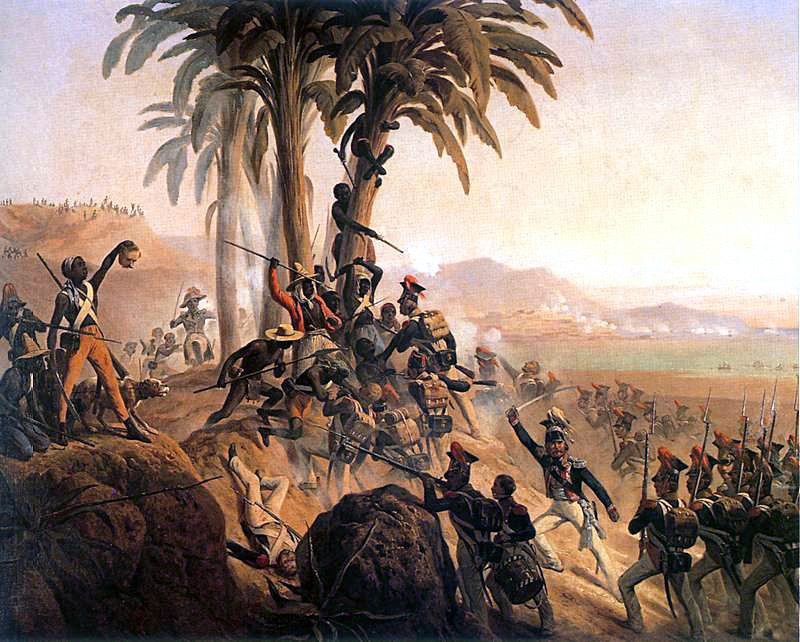
January Suchodolski, “Battle for Palm Tree Hill” (San Domingo), 1845. Public domain, via Wikimedia Commons.
Source: January Suchodolski, oil painting of the Haitian Revolution, painted 1845
(a)Describe ONE choice the painter made in depicting the combatants.
What earns the point
The formerly enslaved Haitian soldiers are shown as a disciplined army assaulting European troops — uniformed, organized, and winning — rather than as a mob; the European force is on the defensive. Any accurate observation about composition, dress, or portrayal of the two sides earns the point.
(b)Explain the historical situation that produced the conflict depicted.
What earns the point
Saint-Domingue’s enslaved majority rose in 1791 amid the French Revolution’s rights language; by 1802–1803 Napoleon sent an expedition to restore slavery and colonial control, and formerly enslaved armies under leaders like Toussaint Louverture and Dessalines fought and defeated it, producing independence in 1804. The point requires situating the battle in the revolution’s course.
(c)Explain ONE effect of the Haitian Revolution beyond Haiti.
What earns the point
It terrified slaveholding societies (hardened slave codes in the U.S. South and Caribbean), inspired enslaved and free Black communities across the Atlantic, contributed to Napoleon selling Louisiana (1803), and made abolition a live political question. Any concrete external effect earns the point.
The great divergence, in one table
| Region | 1750 | 1860 | 1900 |
|---|---|---|---|
| China | 32.8 | 19.7 | 6.2 |
| India / South Asia | 24.5 | 8.6 | 1.7 |
| United Kingdom | 1.9 | 19.9 | 18.5 |
| United States | 0.1 | 7.2 | 23.6 |
Estimates by economic historian Paul Bairoch (1982); widely reproduced in world-history scholarship.
Source: Paul Bairoch, estimates of world manufacturing shares, 1750–1900
(a)Identify ONE change over time shown in the table.
What earns the point
Asia’s share collapsed while Britain’s and then America’s soared — e.g., China fell from roughly a third of world manufacturing to 6%, or the UK rose from under 2% to nearly a fifth. Any accurate reading of a change earns the point.
(b)Explain ONE cause of the change you identified.
What earns the point
British industrialization (mechanized textiles, steam power, factory production) undercut Asian handicraft manufacturing; colonial policy in India dismantled protection for local producers while opening markets to British goods; treaty-port imperialism did similar work in China. Cause must be connected to the direction of change.
(c)Explain ONE way a non-Western state responded to this shift in economic power during the nineteenth century.
What earns the point
Examples: Meiji Japan’s state-led industrialization (factories, railways, banking, military reform); Ottoman Tanzimat reforms; Egypt under Muhammad Ali building state cotton mills; Qing self-strengthening arsenals. The response must be named and tied to confronting Western industrial power.
Independence, dated
| State | Independence | From |
|---|---|---|
| Libya | 1951 | Italy (UN trusteeship) |
| Ghana | 1957 | Britain |
| Nigeria | 1960 | Britain |
| Algeria | 1962 | France |
| Kenya | 1963 | Britain |
| Angola | 1975 | Portugal |
| Mozambique | 1975 | Portugal |
| Zimbabwe | 1980 | Britain (settler rule) |
| Namibia | 1990 | South African control |
Seventeen African states became independent in 1960 alone (“the Year of Africa”).
Source: Independence dates of selected African states, 1951–1990
(a)Identify ONE pattern in the timing shown in the table.
What earns the point
Decolonization clustered in a wave around 1957–1963 but stretched across four decades — Portuguese colonies and settler states came last (1975–1990). Any accurate pattern (the 1960 wave, the late Portuguese/settler cases) earns the point.
(b)Explain ONE reason some territories in the table gained independence much later than others.
What earns the point
Where sizable settler populations or authoritarian metropoles resisted — Portugal’s Estado Novo fought long colonial wars until its 1974 revolution; Rhodesia’s white-minority government declared UDI; Namibia was held by apartheid South Africa — independence required prolonged armed struggle and international pressure. The reason must explain LATENESS.
(c)Explain ONE challenge newly independent African states commonly faced after the dates shown.
What earns the point
Colonial borders enclosing rival communities (civil conflict, secession attempts like Biafra), economies built for raw-material export dependent on former metropoles (neocolonialism), weak institutions and military coups, and Cold War proxy pressures. Any one, concretely stated, earns the point.
AP U.S. History
Counting the colonies
| Year | Total population | Of whom enslaved (approx.) |
|---|---|---|
| 1650 | ~50,000 | ~1,600 |
| 1700 | ~251,000 | ~28,000 |
| 1750 | ~1,171,000 | ~236,000 |
Estimates from Historical Statistics of the United States; enslaved share rose from ~3% to ~20% over the century.
Source: Historical Statistics of the United States, colonial population estimates
(a)Identify ONE trend in the data.
What earns the point
Explosive overall growth (roughly twenty-fold, 1650–1750) OR the even faster growth of the enslaved population, whose share rose from about 3% to about 20%. Either accurate reading earns the point.
(b)Explain ONE cause of the overall population growth shown.
What earns the point
High natural increase (early marriage, abundant land, comparatively low mortality especially in New England), heavy voluntary migration including indentured servants and non-English Europeans (Scots-Irish, Germans), and the forced migration of enslaved Africans. Any cause tied to growth earns the point.
(c)Explain ONE way the growth of the enslaved population changed colonial society by 1750.
What earns the point
Plantation regions consolidated slave codes and race-based hereditary slavery (post-1676 shift from indentured labor), South Carolina developed an enslaved Black majority, and slave-based staple economies (tobacco, rice) tied colonial elites to Atlantic markets. Any concrete social/legal/economic change earns the point.
An engraving as an argument

Paul Revere (after Henry Pelham), “The Bloody Massacre,” engraving, 1770. Public domain, via Wikimedia Commons.
Source: Paul Revere, “The Bloody Massacre perpetrated in King Street,” engraving, Boston, 1770
(a)Describe ONE way the engraving departs from what witnesses reported about the event.
What earns the point
Revere shows an ordered volley fired on command into peaceful, unarmed gentlemen — witnesses described a chaotic street confrontation with a crowd throwing ice and clubs at a small guard detail, and shots fired in confusion. Any accurate contrast (order vs. chaos, innocent victims vs. aggressive crowd, officer commanding fire) earns the point.
(b)Explain the purpose of these choices.
What earns the point
It is propaganda: circulated within weeks to cast British troops as murderers and colonists as martyrs, building outrage against the military occupation of Boston and the ministry behind it. Purpose must connect the visual choices to mobilizing anti-British sentiment.
(c)Explain ONE way images and print culture shaped the coming of the Revolution beyond this event.
What earns the point
Committees of correspondence, pamphlets (Common Sense circulated on an enormous scale — its printers claimed 100,000+ copies within months, a figure historians debate), newspapers reprinting grievances, and engravings created a shared inter-colonial narrative of tyranny — turning local incidents into continental causes. Any concrete print-culture mechanism earns the point.
Drawing the line at 36°30′

Map of the Missouri Compromise, 1820. Public domain, via Wikimedia Commons.
Source: Map of the United States after the Missouri Compromise, 1820
(a)Describe ONE feature of the sectional arrangement shown on the map.
What earns the point
The 36°30′ line divides the Louisiana Purchase: slavery permitted south of it, prohibited north of it, with Missouri admitted as a slave state and Maine as a free state to preserve Senate balance. Any accurate feature (the line, the paired admissions, the free/slave count) earns the point.
(b)Explain ONE reason Congress adopted this arrangement.
What earns the point
Missouri’s application as a slave state threatened the exact balance of free and slave states in the Senate; the compromise preserved sectional parity and postponed a constitutional confrontation over Congress’s power to restrict slavery in the territories. The balance-of-power logic must be explicit.
(c)Explain ONE way this arrangement broke down by the 1850s.
What earns the point
The Mexican Cession reopened the territorial question the line did not cover; the Kansas-Nebraska Act (1854) repealed the 36°30′ restriction in favor of popular sovereignty, producing Bleeding Kansas; Dred Scott (1857) declared congressional restriction unconstitutional. Any one, accurately connected to the compromise’s collapse, earns the point.
The arriving millions
| Decade | Arrivals |
|---|---|
| 1841–1850 | 1.7 million |
| 1851–1860 | 2.6 million |
| 1861–1870 | 2.3 million |
| 1871–1880 | 2.8 million |
| 1881–1890 | 5.2 million |
| 1891–1900 | 3.7 million |
| 1901–1910 | 8.8 million |
Official arrival counts, U.S. immigration statistics.
Source: U.S. immigration arrivals by decade, official statistics
(a)Identify ONE trend in the data.
What earns the point
Immigration surged after 1880, roughly doubling the mid-century pace and peaking at 8.8 million in 1901–1910. Any accurate trend (the post-1880 surge, the 1890s dip amid depression, the 1900s peak) earns the point.
(b)Explain ONE cause of the surge after 1880.
What earns the point
Industrial labor demand (steel, meatpacking, textiles, railroads) pulled migrants while steamship lines cut crossing costs; push factors in southern and eastern Europe — rural poverty, population growth, pogroms against Jews in the Russian Empire — supplied the movers. Cause must be tied to the post-1880 rise.
(c)Explain ONE response within the United States to this immigration.
What earns the point
Nativist organizing (the American Protective Association, the Immigration Restriction League’s literacy-test campaign), the Chinese Exclusion Act (1882) as the first national ban by nationality, urban political machines incorporating immigrant voters, and settlement houses like Hull House. Any concrete response earns the point.
The state asks for you

James Montgomery Flagg, U.S. Army recruiting poster, 1917. Public domain, via Wikimedia Commons.
Source: James Montgomery Flagg, “I Want YOU for U.S. Army,” recruiting poster, 1917
(a)Describe ONE persuasive technique the poster uses.
What earns the point
Personification of the nation as Uncle Sam making direct eye contact and pointing at the individual viewer (“YOU” capitalized) — converting an abstract national need into a personal, unavoidable demand. Any accurate technique (direct address, patriotic symbolism, imperative text) earns the point.
(b)Explain the historical situation in which the poster was produced.
What earns the point
The United States entered World War I in April 1917 with a small peacetime army; the government needed millions of soldiers fast, pairing the Selective Service Act’s draft with a massive persuasion campaign run through the Committee on Public Information. Situating the poster in 1917 mobilization earns the point.
(c)Explain ONE other way the U.S. government mobilized society for the war effort.
What earns the point
The War Industries Board directed production; Liberty Bond drives financed the war; the Food Administration pushed voluntary rationing (“wheatless Mondays”); the Espionage and Sedition Acts policed dissent; the CPI flooded the country with propaganda. Any one, accurately described, earns the point.
The boom, year by year
| Year | Births |
|---|---|
| 1936 | ~2.4 million |
| 1946 | ~3.4 million |
| 1952 | ~3.9 million |
| 1957 | ~4.3 million (peak) |
| 1964 | ~4.0 million |
| 1973 | ~3.1 million |
U.S. vital statistics; the “baby boom” is conventionally dated 1946–1964.
Source: U.S. live births, selected years, national vital statistics
(a)Identify ONE pattern in the data.
What earns the point
Births jumped sharply right after World War II and stayed elevated for nearly two decades, peaking in 1957 at roughly 4.3 million — far above Depression-era levels — before falling in the 1960s–70s. Any accurate pattern earns the point.
(b)Explain ONE cause of the increase shown between 1936 and 1957.
What earns the point
Postwar prosperity and confidence: rising real wages, GI Bill benefits (education, home loans), earlier marriage, suburban housing construction, and cultural celebration of domesticity after depression and war postponed family formation. Cause must connect conditions to childbearing decisions.
(c)Explain ONE effect of this demographic change on American society after 1957.
What earns the point
School construction booms and later university expansion; suburban growth and the car-centered consumer economy (from Levittowns to shopping centers); a youth-centered mass culture feeding 1960s social movements; long-term pressure on Social Security as the cohort aged. Any concrete downstream effect earns the point.