The era we’re still inside.
Bretton Woods, the WTO, the internet, China’s rise, climate change, populism — the era we’re still inside.
After 1991, the U.S.-led liberal economic order spread: GATT became the WTO; NAFTA opened North America; China entered the WTO in 2001 and became the world’s manufacturing hub. The internet shrank distances; smartphones reshaped culture. The 2008 financial crisis exposed fragility; populism surged in the 2010s and 2020s. Climate change is the era’s defining ecological fact. We are the period we’re studying.
The unit, topic by topic.
Beyond the AP rubric: the era behind Unit 9
The 1900–present stretch in this unit lives inside a much wider story. For long-form context — themes, primary sources, and the moments that didn’t make the CED — read the era page(s):
9.1
Advances in Technology and Exchange
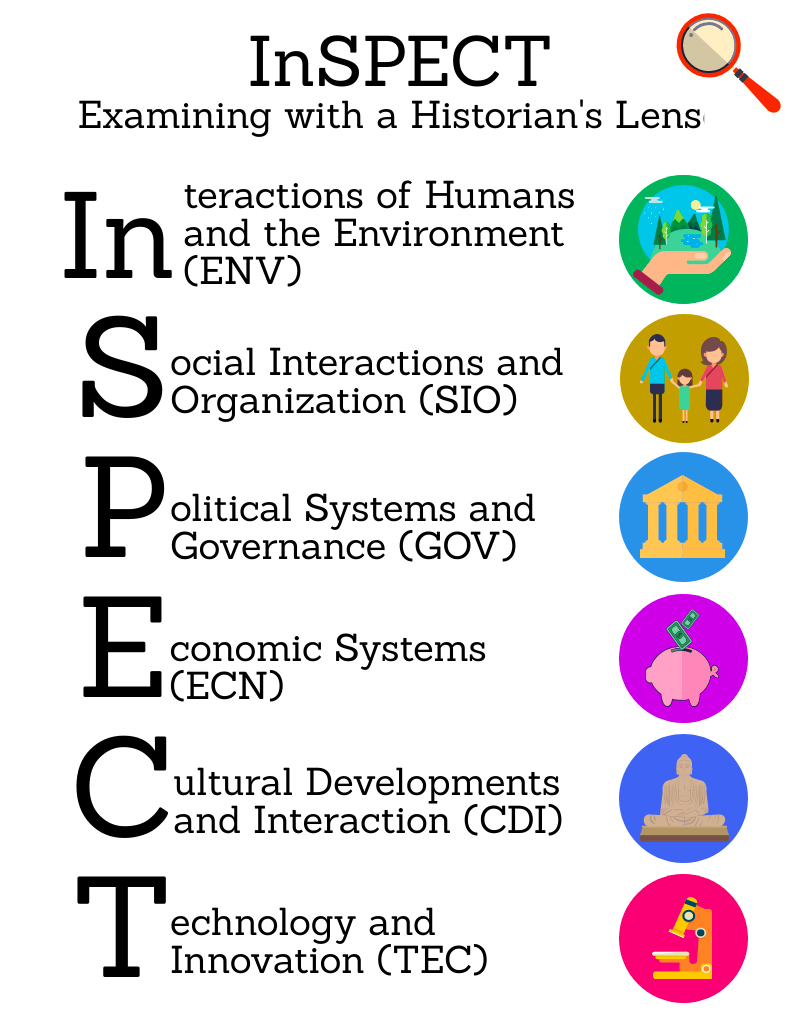
Transportation, communication, biotech.TEC · CDIWhat to studyLate-20th-century technology accelerated everything. Container shipping (1956 onward) cut shipping costs ~95%, making global supply chains economical. Commercial jet aircraft (1958) shrank the world. The internet (commercialized 1990s) connected information instantly and globally; smartphones (2007 onward) put it in everyone’s pocket. Biotechnology revolutionized agriculture (Green Revolution, GMOs) and medicine (recombinant DNA, gene therapy, mRNA vaccines). Each advance compounded the others.
Key termsContainer shipping · Internet · Smartphones · Green Revolution · BiotechnologyExam focusTech matters when paired with consequences. Container shipping enabled Chinese manufacturing dominance.Primary sourceTim Berners-Lee, Proposal for the World Wide Web, 1989 — World Wide Web Consortium (W3C)
The document that invented the internet as a public communication system — primary evidence of how a single technological innovation transformed global exchange within a decade.Whose story is missing?“The imagination has become an organized field of social practices, a form of work… and a form of negotiation between sites of agency and globally defined fields of possibility. Ordinary people have begun to deploy their imaginations in the practice of their everyday lives.” — Arjun Appadurai, Modernity at Large: Cultural Dimensions of Globalization, 1996
Appadurai (b. 1949), a Mumbai-born anthropologist at New York University, developed some of the most influential frameworks for understanding globalization’s cultural dimensions. He argued that globalization was not simply economic but involved flows of ideas, images, and identities across national borders—and that these flows were not one-directional from West to Rest. His work represents the Global South scholarly perspective on globalization that is typically missing from AP World’s coverage of technology and exchange. Read the source →
9.2
Technological Advances and Limitations: Disease
Medicine, pandemics, public health.TEC · ENV · SIOWhat to studyAntibiotics (penicillin, 1928 industrial production 1940s) and vaccination programs nearly eliminated some infectious diseases (smallpox eradicated 1980; polio nearly so). Public health—sanitation, clean water, child immunization—doubled life expectancy in the 20th century. But new pandemics emerged: HIV/AIDS (~40 million dead since the 1980s); COVID-19 (~7 million confirmed dead since 2020). Antibiotic resistance threatens to roll back gains. The medical revolution is real but incomplete and unequal.
Key termsVaccination · Smallpox eradication · HIV/AIDS · COVID-19 · Antibiotic resistanceExam focusCite specific diseases and the public-health responses. Pair successes (smallpox) with limits (HIV, COVID).Primary sourceWorld Health Organization, Global Strategy for AIDS, 1987 — World Health Organization
The WHO’s first coordinated global response to HIV/AIDS — evidence of how modern disease required international institutions and exposed the limits of national responses to global health crises.Whose story is missing?“In an age of explosive development in the realm of medical technology, it is unnerving to find that the discoveries of Salk, Sabin, and even Pasteur remain irrelevant to much of humanity.” — Dr. Paul Farmer, Pathologies of Power: Health, Human Rights, and the New War on the Poor (University of California Press, 2003), p. 144
Farmer (1959–2022) was an American physician and anthropologist who founded Partners in Health and spent decades providing medical care in Haiti, Rwanda, and other Global South countries. His book documented how health outcomes were determined not by biology or technology but by political economy: who gets treated, at what speed, with what resources, is a function of whose lives are considered worth saving. COVID-19 later demonstrated exactly the vaccine access inequality he had described. Read the source →
9.3
Technological Advances: Environment
Climate change, energy transitions, ecological costs.ENV · TECWhat to studyIndustrial-era CO₂ emissions have driven measurable global warming since the late 20th century. Effects: more extreme weather, sea-level rise, ecosystem disruption, climate refugees. Responses: international agreements (Kyoto 1997, Paris 2015), shifts to renewables (solar, wind), debates over nuclear power. The transition is uneven and contested—rich countries built their wealth on fossil fuels and now ask poorer countries to skip them. Climate change is the era’s defining environmental fact.
Key termsClimate change · CO₂ emissions · Paris Agreement · Renewables · Climate justiceExam focusClimate questions appear on the FRQ. Cite specific agreements, technologies, and tensions.Primary sourceUnited Nations, Rio Declaration on Environment and Development, 1992 — United Nations, via Internet Archive
The Rio Declaration’s 27 principles — the international community’s first binding commitment to sustainable development and the primary source of the modern environmental governance framework.Whose story is missing?“no one’s drowning, baby / no one’s moving / no one’s losing their homeland / no one’s gonna become a climate change refugee” — Kathy Jetnil-Kijiner, “Dear Matafele Peinem,” performed at the United Nations Climate Summit opening ceremony, New York, September 23, 2014
Jetnil-Kijiner (b. 1987) delivered a poem at the 2014 UN Climate Summit that went viral—a letter to her infant daughter promising to fight so the Marshall Islands would not sink beneath rising seas. The Marshall Islands produces less than 0.001% of global greenhouse gas emissions but faces complete disappearance within decades due to sea-level rise caused by the emissions of industrialized nations. Her voice represents the Pacific Island nations that are on the frontline of a crisis they did not cause. Read the source →
9.4
Economics in the Global Age
Bretton Woods, free trade, China’s rise.ECNWhat to studyThe Bretton Woods system (1944) set up the IMF, World Bank, and dollar gold standard, organizing the postwar Western economy. The shift to free trade accelerated through GATT (1947) and the WTO (1995). Manufacturing migrated from rich-world unionized workers to low-wage countries (Mexico via NAFTA 1994; China after WTO accession 2001). China’s rise—from 4% of global GDP in 1990 to ~18% in 2024—was the era’s biggest economic story. The 2008 financial crisis exposed the fragility of integrated finance.
Key termsBretton Woods · IMF / World Bank · WTO · NAFTA · 2008 crisis · China riseExam focusDon’t just say “globalization.” Cite SPECIFIC institutions and SPECIFIC effects on labor markets.Primary sourceWTO Agreement, Preamble, 1994 — World Trade Organization
The WTO founding document frames globalization as the path to prosperity — primary evidence of the economic ideology that both integrated the global economy and fueled resistance to it.Whose story is missing?“Another world is not only possible, she is on her way. On a quiet day, I can hear her breathing.” — Arundhati Roy, speech at the World Social Forum, Porto Alegre, Brazil, January 27, 2003
Roy (b. 1961), Indian novelist and activist, delivered this address at the World Social Forum—the anti-globalization movement’s annual counter-summit to the World Economic Forum in Davos. She documented how the Bretton Woods institutions (IMF, World Bank, WTO) had locked Global South nations into trade agreements that benefited wealthy nations at their expense. Her words became a slogan of the global justice movement. They represent the perspective of those for whom economic globalization has meant dispossession rather than development. Read the source →
9.5
Calls for Reform and Responses
NGOs, populism, anti-globalization.GOV · SIOWhat to studyDiscontent with the global order produced multiple movements. Anti-globalization protests (Seattle 1999, Genoa 2001) targeted the WTO and IMF. NGOs (Doctors Without Borders, Greenpeace, Human Rights Watch) built transnational advocacy networks. From the 2010s onward, populist nationalism rose: Brexit (2016), Trump’s 2016 victory, Modi in India, Bolsonaro in Brazil, Orbán in Hungary. The pendulum has swung between integration and reaction; current politics is the swing.
Key termsWTO protests · NGOs · Populism · Brexit · Authoritarian populismExam focusConnect economic conditions to political backlash. The 2008 crisis directly preceded populist surges.Primary sourceUniversal Declaration of Human Rights, 1948 — United Nations
The UN’s foundational rights document — the reference point for every reform movement since 1948, from decolonization to women’s rights to indigenous rights to environmental justice.Whose story is missing?“We have nothing to lose, absolutely nothing—no decent roof over our heads, no land, no work, poor health, no food, no education, no right to freely and democratically elect our officials, no independence from foreigners, no peace or justice for ourselves and our children.” — EZLN Zapatista Army of National Liberation, First Declaration of the Lacandon Jungle, Chiapas, Mexico, January 1, 1994
The Zapatistas launched their uprising on January 1, 1994—the day NAFTA went into effect—in Chiapas, Mexico’s poorest state. The timing was deliberate: they argued that the free trade agreement would accelerate the dispossession of Indigenous Mexican communities. Their declaration, written in the name of the Indigenous Maya peoples of Chiapas, drew on five hundred years of colonial history to explain a contemporary uprising. They became one of the defining voices of the anti-globalization movement. Read the source →
9.6
Globalized Culture
Media, sports, religion, syncretism.CDIWhat to studyGlobal culture is partly homogenizing (Hollywood, K-pop, Premier League soccer, English as global lingua franca) and partly diversifying (regional revivals, religious resurgence, digital subcultures). Religious pluralism: Pentecostalism’s explosion in Africa and Latin America; political Islam’s post-1979 prominence; Buddhism in the West. Western consumer culture spreads with Coca-Cola and McDonald’s, but also gets adapted everywhere it lands. Identity politics—national, ethnic, religious, gendered—is the era’s new political idiom.
Key termsHollywood · K-pop · Pentecostalism · Political Islam · Identity politicsExam focusPair homogenization (English, Hollywood) with diversification (regional revivals). Both happen at once.Primary sourceKofi Annan, We the Peoples (Millennium Report, Chapter 1), 2000 — United Nations
The UN Secretary-General’s report at the Millennium Summit frames globalization’s benefits and inequalities — a primary source on how the global community understood cultural and economic change at century’s end.Whose story is missing?“The single story creates stereotypes, and the problem with stereotypes is not that they are untrue, but that they are incomplete. They make one story become the only story. And the consequence of a single story is this: It robs people of dignity. It makes our recognition of our equal humanity difficult.” — Chimamanda Ngozi Adichie, “The Danger of a Single Story,” TED Talk, Oxford, July 2009
Adichie (b. 1977), a Nigerian novelist, delivered this talk describing how Western media and literature had presented Africa as a single, impoverished, disaster-prone continent—and how that single story had shaped her own early perceptions of Mexico, and of herself. Her argument is directly relevant to globalized culture: the flow of media across borders is not neutral. The stories that dominate global media come from particular places and serve particular interests, and they shape how billions of people understand each other. Read the source →
9.7
Resistance, Continuity, Change
What’s actually new since 1900.GOV · SIOWhat to studyOn a continuity-and-change FRQ for the 20th–21st century: CHANGES include scale of state, mass democracy, decolonization, women’s public rights, technological speed, climate as political fact, end of European hegemony. CONTINUITIES include great-power rivalry (now U.S.–China), commodity dependence in much of the Global South, ethnic and religious conflict, gender hierarchies in much of the world, capitalist organization of production. The 20th century broke many things, but not everything.
Key termsContinuity · Change · Decolonization · Great-power rivalry · CapitalismExam focusFor continuity-and-change essays: pick 2 strong CHANGES and 2 strong CONTINUITIES with specific evidence each.Primary sourceArundhati Roy, The Ordinary Person’s Guide to Empire (excerpt), 2004 — Third World Traveler
Roy articulates the global justice movement’s critique of U.S. imperialism and corporate globalization — the resistance perspective that challenged both continuity and the dominant narrative of progress.Whose story is missing?“Decoloniality means first to delink (to detach) from that overall structure of knowledge in order to engage in an epistemic reconstitution. Reconstitution of what? Of ways of thinking, languages, ways of life and being in the world that the rhetoric of modernity disavowed and the logic of coloniality implement.” — Walter Mignolo, “Interview – Walter Mignolo/Part 2: Key Concepts,” E-International Relations, January 21, 2017
Mignolo (b. 1941), an Argentine semiotician and scholar at Duke University, developed the concept of the “colonial matrix of power”—the argument that colonialism did not end with political independence but continues in the structures of knowledge, economics, and governance that former colonial powers established. His work asks: if the AP World History course itself is organized around a periodization and set of categories developed by European and North American scholars, whose “world” does it actually describe? Read the source →
9.8
Institutions Developing in a Globalized World
The UN, the IMF, NGOs — who governs beyond the state.GOV · ECNWhat to studyThe end of the Cold War reshaped global politics in ways still working themselves out. The “unipolar moment” of American dominance in the 1990s turned out to be brief, and the attacks of 11 September 2001 pulled the United States into two decades of war. But states were never the only actors. The United Nations, founded in 1945 with 51 members, grew to 193 as decolonisation ran its course, and its agencies took on work no single government could do — the World Health Organization’s smallpox eradication, refugee protection, peacekeeping. Economic institutions — the IMF, the World Bank, the WTO — set terms that shaped what individual states could afford to do, and non-governmental organisations built real influence while holding no territory at all.
Key termsUnited Nations · World Health Organization · IMF · World Bank · WTO · NGOs · Unipolar momentExam focusInstitutions are actors, so treat them like actors: name a specific institution, a specific thing it did, and a specific limit on its power. The limit is usually where the complexity point is.Primary sourceCharter of the United Nations, signed at San Francisco, 26 June 1945 — United Nations, published for free reproduction
The Charter opens “WE THE PEOPLES”, not “we the governments” — yet only governments signed it and only governments vote in it. That tension is the whole topic in one line.9.9
Continuity and Change in a Globalized World
Argue how far science and technology actually changed things.TEC · ECN · SIOWhat to studyThe unit’s capstone, and an argumentation topic rather than a new body of content. The College Board learning objective asks you to explain the extent to which science and technology brought change from 1900 to the present, and “extent” is the word that decides the essay: the answer is never all or nothing. Argue both sides. Technology genuinely transformed communication, transport, medicine and food — antibiotics and vaccines, the Green Revolution, containerised shipping, the internet. And yet it dissolved much less than it promised: inequality between and within states persisted, the nation-state remained the unit that matters, and the environmental costs tracked in Topic 9.3 grew alongside the gains. The strongest answers name a specific technology, the specific change it produced, and something specific that did NOT change in spite of it.
Key termsContinuity and change · Green Revolution · Antibiotics and vaccines · Containerization · Internet · Extent of changeExam focusAn “extent” prompt wants a qualified answer with a stated criterion. Say what would count as transformation, then show where the evidence clears that bar and where it does not. Suggested skill for this topic is argumentation (6.D): corroborate, qualify, or modify a claim using alternative evidence.Source pairingNo new document here — this topic asks you to argue from what you already have. Set the technology optimism of Topic 9.1 against the environmental debates of Topic 9.3 and the inequality in Topic 9.4, and decide which case the evidence actually supports.
Practice LEQ stem.
Connect to your study
Era page: see the Eras of World History hub for the period’s broader global context.
Practice: FRQ Lab · Practice MCQs · Unit 9 flashcards
The terms that stick.
Flip a card, then be honest: got it, or again? Missed cards come back first. 30 terms. Progress saves on this device and shows up in your plan.
Done reading? Run the cycle.
Six steps for this unit. Checks save on this device and show up in your plan.