The crisis of European hegemony.
World War I, the interwar crisis, World War II — and the systematic atrocities of total war.
World War I (1914–1918) ended the long 19th century: ~17 million dead, the European empires shattered, and the Treaty of Versailles building grievances that fascists would exploit. The Great Depression (1929–) discredited liberal capitalism. World War II (1939–1945) killed ~60 million—including the Holocaust’s six million. Total war made civilians into combatants. The era ended with European hegemony broken, two superpowers ascendant, and the atomic bomb in the world.
The unit, topic by topic.
Beyond the AP rubric: the era behind Unit 7
The 1900–present stretch in this unit lives inside a much wider story. For long-form context — themes, primary sources, and the moments that didn’t make the CED — read the era page(s):
7.1
Shifting Power After 1900
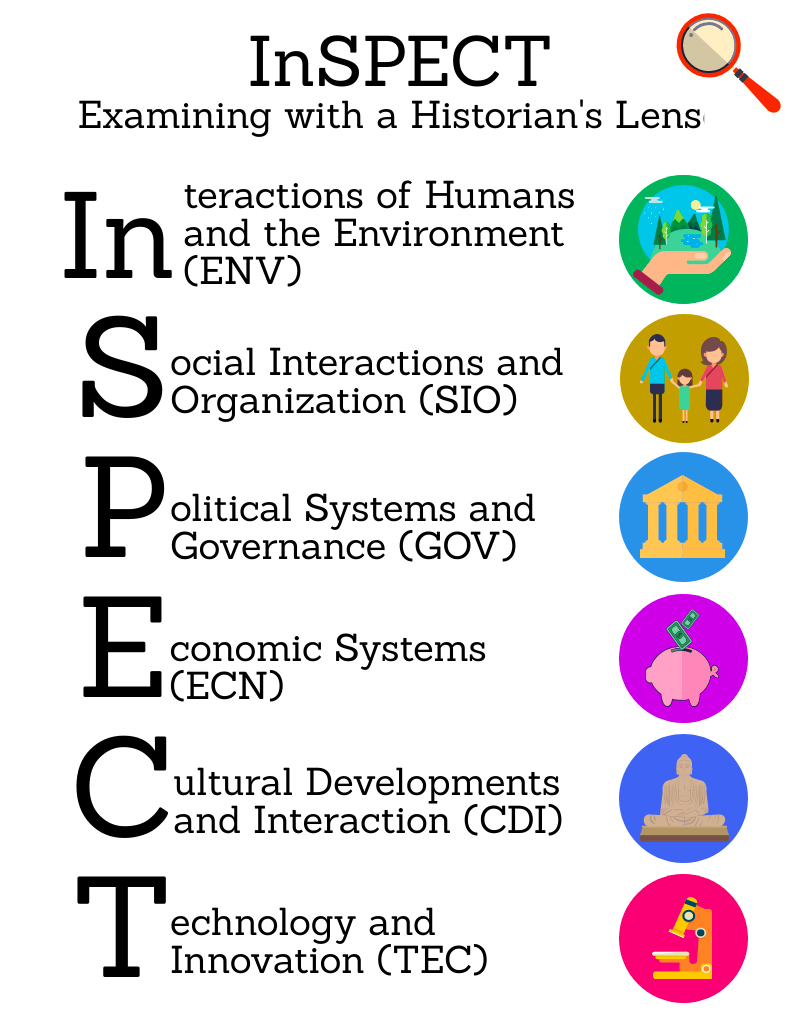
Why the European order was unstable.CDI · GOVWhat to studyBy 1900, several pressures had built up. Germany (united 1871) was an industrial powerhouse with a small colonial empire and wanted “a place in the sun.” Britain felt threatened. Russia, weakened by the 1905 revolution, sought stability through alliance. Austria-Hungary was a multinational empire fragmenting under nationalist pressure (especially in the Balkans). The Ottoman Empire was visibly declining. Alliance systems (Triple Alliance vs. Triple Entente) hardened these tensions into commitments that would convert any local conflict into a continental one.
Key termsTriple Alliance · Triple Entente · Balkans powder keg · German WeltpolitikExam focusDon’t just list alliances. Explain WHY each major power was nervous, and what they thought war might fix.Primary sourceVladimir Lenin, Imperialism, the Highest Stage of Capitalism (Chapter 7), 1917 — Project Gutenberg
Lenin argues capitalist competition for markets causes inter-imperial war — the most influential explanation for WWI from the perspective of the revolutionary forces it unleashed.Whose story is missing?“The discovery of personal whiteness among the world’s peoples is a very modern thing—a nineteenth and twentieth century matter indeed. The ancient world would have laughed at such a distinction.” — W.E.B. Du Bois, “The Souls of White Folk,” in Darkwater: Voices from Within the Veil, 1920
Du Bois (1868–1963) wrote this essay as World War I was ending. He argued that the war was not a crisis of European civilization but the inevitable consequence of a global racial order that European nations had built through colonialism. He connected the violence of the trenches to the violence of empire: the same nations that competed to rule Africa and Asia brought that competition home to Europe. His analysis anticipated anti-colonial thought by decades. Read the source →
7.2
Causes of World War I
Long-term and short-term causes.CDI · GOVWhat to studyLong-term causes (MAIN): Militarism (arms race, especially German naval expansion), Alliances (Triple A vs. Triple E), Imperialism (colonial competition), Nationalism (especially in the Balkans). Short-term cause: The June 28, 1914 assassination of Archduke Franz Ferdinand by Gavrilo Princip in Sarajevo. Austria-Hungary issued an ultimatum to Serbia; Russia mobilized; Germany declared war on Russia and France; Britain declared war on Germany after the German invasion of Belgium. Within five weeks, all of Europe was at war.
Key termsSarajevo · MAIN causes · Schlieffen Plan · Mobilization · July CrisisExam focusConnect long-term structures to the short-term trigger. Why was the assassination ABLE to start a world war?Primary sourceKaiser Wilhelm II, Speech at the Opening of the Reichstag, August 1914 — Fordham Internet History Sourcebooks — no longer available online
Wilhelm frames Germany’s entry into WWI as defensive necessity — primary evidence of how nationalist ideology and alliance systems pulled Europe into war.Whose story is missing?“Since the victory of the Allies, all the subject peoples are frantic with hope at prospect of an era of right and justice which should begin for them by virtue of the formal and solemn engagements, made before the whole world by the various powers of the entente in the struggle of civilization against barbarism. While waiting for the principle of national self-determination to pass from ideal to reality through the effective recognition of the sacred right of all peoples to decide their own destiny…” — Nguyễn Ái Quốc (Ho Chi Minh), “Claims of the Annamite People” (Revendications du Peuple Annamite), submitted to the Paris Peace Conference, Paris, June 18, 1919
The future Ho Chi Minh traveled to Versailles in 1919 to petition the Allied powers for Vietnamese independence from France, citing Woodrow Wilson’s Fourteen Points and the principle of self-determination. He was ignored. The Paris Peace Conference, which claimed to be reorganizing the world on principles of national self-determination, applied those principles only to European peoples. His petition documents the colonial subjects watching the peace conference from outside its doors. Read the source →
7.3
Conducting World War I
Trench warfare, total war, global theaters.TEC · SIOWhat to studyOn the Western Front, machine guns and barbed wire made offense suicidal; battles like Verdun and the Somme each killed hundreds of thousands. Total war mobilized civilian economies: rationing, women in factories, propaganda. Theaters extended beyond Europe: the Ottomans fought British and Arab forces in the Middle East; Africa’s colonies were drawn in; Japan seized German Pacific holdings. New technology: poison gas, tanks, aircraft, submarines. The war that everyone expected to be “over by Christmas” lasted four years.
Key termsTrench warfare · Total war · Verdun · Somme · Tanks · U-boats · PropagandaExam focusCite SPECIFIC battles and SPECIFIC technologies. Connect tactics (offense vs. defense) to casualties.Primary sourceWilfred Owen, Dulce et Decorum Est, 1917 — Poetry Foundation
Owen’s poem on a gas attack is the defining anti-war text of WWI — primary evidence of how industrialized warfare transformed the experience of combat.Whose story is missing?“We are here in France, in the mud and the cold. Brothers fall beside us every day. And all the while India is still under the English. We are fighting for England. England is not fighting for us.” — from letters of Indian soldiers, British Expeditionary Force censor records, France, 1915–1917 (India Office Records, British Library)
Approximately 1.5 million Indian soldiers served in WWI for the British Empire — in France, Mesopotamia, Gallipoli, and East Africa. British military censors intercepted and translated their letters home; those translated records, preserved in the India Office Records at the British Library, are the most direct accounts we have of colonial soldiers’ inner lives during the war. These men received lower pay than British troops, served under British officers, and returned to a country still under colonial rule. The Amritsar Massacre — in which British troops fired on unarmed Indian civilians — occurred just one year after Indian soldiers helped win the war. Wilfred Owen is not a missing voice; he is the most-taught text of WWI. The Indian soldiers who fought the same war, in the same mud, questioning the same lie — they are the missing perspective. Read the source →
7.4
Economy in the Interwar Period
Boom, crash, depression, response.ECNWhat to studyThe 1920s seemed prosperous in the U.S. and (briefly) Germany, but the gold-standard global economy was fragile. The 1929 U.S. stock market crash exposed and amplified weaknesses: bank failures, deflation, demand collapse. By 1933, U.S. unemployment hit 25%; German unemployment was higher. Governments responded variously: U.S. New Deal (federal jobs and welfare), German Nazi remilitarization, Soviet Five-Year Plans, Japan’s aggressive imperial expansion. The Depression discredited liberal capitalism in much of the world and empowered radical alternatives.
Key termsStock market crash · Great Depression · New Deal · Nazi economy · Five-Year PlansExam focusDistinguish the responses. Why did some democracies survive (U.S., U.K.) and others didn’t (Germany, Italy)?Primary sourceJohn Maynard Keynes, The Economic Consequences of the Peace (Chapter 2), 1919 — Project Gutenberg
Keynes predicts the Treaty of Versailles will cause economic collapse in Europe — a contemporary analysis of why the interwar economy failed.Whose story is missing?“The exploitation of our oil has brought to Mexico only what the companies chose to leave behind. The wealth goes out and the poverty stays. I am not nationalizing oil to harm our partners; I am nationalizing it to give Mexico what is rightfully Mexico’s.” — Lázaro Cárdenas, presidential address on the nationalization of foreign oil companies, Mexico City, March 18, 1938 (translated from Spanish)
Cárdenas (1895–1970) nationalized U.S. and British oil companies operating in Mexico in 1938, the first major nationalization of foreign natural resources in the Americas. His address documented the relationship between commodity-producing nations and the industrial powers that extracted their resources—the global economic structure that produced the interwar Depression unevenly. His action became a model for resource nationalism across the Global South. Read the source →
7.5
Unresolved Tensions Post-WWI
Versailles, the Mandates, and the seeds of WWII.ECN · GOVWhat to studyThe Treaty of Versailles (1919) imposed war guilt and reparations on Germany (the specific 132 billion gold marks figure — about $33 billion — was set by the 1921 London Schedule), redrew European borders, and dismantled the Ottoman Empire into League of Nations Mandates run by the victors. Wilson’s League of Nations was created but the U.S. didn’t join. Italy felt cheated of promised territory. Japan saw racial inequality clauses rejected. Germans saw the treaty as a national humiliation. The interwar order was built on resentments that fascist movements would exploit. By 1939, Hitler had unwound it.
Key termsTreaty of Versailles · War guilt · Mandates · League of Nations · Stab-in-the-back mythExam focusVersailles is the bridge between the wars. Cite specific provisions and explain how Hitler used them politically.Primary sourceTreaty of Versailles, War Guilt Clause (Article 231), 1919 — Yale Avalon Project
Article 231 assigns Germany sole responsibility for WWI and triggers reparations — the unresolved grievance that fueled nationalism, economic crisis, and the rise of fascism.Whose story is missing?“The Arabs and their Allies are ready to fight on the side of Britain and to cooperate with her… In return, we ask that Britain acknowledge the independence of the Arab nation and its right to govern itself according to its own traditions and laws.” — Sharif Hussein ibn Ali, letter to Sir Henry McMahon, British High Commissioner in Egypt, July 14, 1915 (the Hussein-McMahon Correspondence)
Sharif Hussein (1853–1931), the Sharif of Mecca, negotiated this correspondence with Britain during World War I—promising an Arab Revolt against the Ottomans in exchange for British support for Arab independence. Britain agreed. The subsequent Sykes-Picot Agreement (1916), which secretly divided the same territory between Britain and France, and the Balfour Declaration (1917), which promised a Jewish homeland in Palestine, contradicted these promises. Hussein’s letters are the foundation of the Arab grievance against the post-WWI settlement. Read the source →
7.6
Causes of World War II
Fascist aggression, appeasement, Pacific expansion.GOV · CDIWhat to studyCauses: Hitler’s revanchist Germany rearmed (1935), reoccupied the Rhineland (1936), absorbed Austria (Anschluss 1938), and annexed the Sudetenland after the Munich Agreement (1938). Britain and France’s appeasement encouraged him; the Molotov-Ribbentrop Pact (Aug 1939) cleared his eastern flank. Italy invaded Ethiopia (1935). Japan invaded Manchuria (1931) and China (1937), then Pearl Harbor (Dec 1941). The war that began September 1939 became truly global by late 1941.
Key termsAnschluss · Munich Agreement · Appeasement · Molotov-Ribbentrop · Pearl HarborExam focusDistinguish European and Pacific causes. They’re related but distinct chains.Primary sourceAdolf Hitler, Mein Kampf (Chapter 1 excerpt), 1925 — Project Gutenberg Australia
Hitler articulates racial nationalism, anti-Semitism, and Lebensraum — the ideology that caused WWII, directly traceable to the failures of Versailles and the Great Depression.Whose story is missing?“The President and the Government submit to the conditions of the Munich Agreement which has come into being without Czechoslovakia and against her.” — Kamil Krofta, Czechoslovak Foreign Minister, statement to the British, French, and Italian ministers, Prague, September 30, 1938 (Avalon Project, Yale Law School)
Masaryk (1886–1948), son of Czechoslovakia’s founder, was serving as Czech minister to Britain when the Munich Agreement was signed. Britain and France agreed to transfer the Sudetenland to Nazi Germany without Czechoslovakia’s participation. His reaction, recorded by British officials and journalists, captures the perspective of the small states whose territories the great powers traded in their attempts to appease Hitler. His question—what kind of justice divides a nation without consulting it?—echoes across the interwar period. Read the source →
7.7
Conducting World War II
European, Pacific, and Eastern theaters.TEC · SIOWhat to studyThe Eastern Front was the bloodiest: Operation Barbarossa (June 1941) cost millions of Soviet lives but bled the Wehrmacht; Stalingrad (1942–43) and Kursk (1943) were turning points. The Western theater: Battle of Britain (1940), Italian and North African campaigns, D-Day (June 1944), Battle of the Bulge, V-E Day (May 1945). The Pacific: Pearl Harbor, Midway (1942), island-hopping, the firebombing of Japanese cities, atomic bombs (Hiroshima Aug 6, Nagasaki Aug 9, 1945). Total war meant civilian targeting was the norm, not the exception.
Key termsStalingrad · D-Day · Battle of Midway · Atomic bomb · FirebombingExam focusCite turning points by name and date. The Eastern Front killed more people than all other theaters combined.Primary sourceNanjing Massacre: Survivor Testimonies, 1937–38 — Fordham Internet History Sourcebooks
Survivor accounts of the Japanese occupation of Nanjing document atrocity as a deliberate military strategy — illustrating how WWII was conducted differently in the Pacific theater.Whose story is missing?“At 8:15 on the morning of August 6, 1945, I was a thirteen-year-old schoolgirl two kilometers from the center of Hiroshima. Suddenly there was a blinding flash of light. The world turned white, then dark. When I woke, I was buried under rubble, and around me was a city that no longer existed.” — Setsuko Thurlow, Hiroshima survivor, Nobel Peace Prize ceremony acceptance speech (on behalf of ICAN), Oslo, December 10, 2017
Thurlow (b. 1932) survived the atomic bombing of Hiroshima and became one of the most prominent voices for nuclear disarmament. Her testimony, delivered at the Nobel Peace Prize ceremony, documents the experience of civilians at the center of total war. AP World covers WWII through strategy, technology, and geopolitical outcomes. Thurlow’s account represents the 70,000–80,000 people killed instantly at Hiroshima and the survivors whose lives were permanently altered—the human content of the phrase “strategic bombing.” Read the source →
7.8
Mass Atrocities After 1900
Genocide and crimes against humanity.SIO · GOVWhat to studyThe 20th century industrialized atrocity. The Armenian genocide (1915–1923) killed ~1.5 million. The Holocaust — Nazi persecution from 1933, industrial-scale mass killing 1941–1945 — killed 6 million Jews and ~5 million others (Roma, disabled, Soviet POWs, gay men). Stalin’s Holodomor (1932–33) killed millions of Ukrainians. The Rape of Nanjing (1937), the Bengal famine (1943), the firebombing of Dresden and Tokyo, the atomic bombings—each tested what “war” and “civilian” could mean. The 1948 Genocide Convention and Universal Declaration of Human Rights tried to set new limits.
Key termsArmenian genocide · Holocaust · Holodomor · Nanjing · Genocide Convention · UDHRExam focusBe specific about which group killed whom and when. Don’t lump atrocities into one category.Primary sourceElie Wiesel, Night (Preface), 1955 — Facing History & Ourselves
Wiesel’s memoir of Auschwitz is the Holocaust’s most widely read testimony — primary evidence of the systematic mass atrocity enabled by modern state power and industrial technology.Whose story is missing?“Never shall I forget that night, the first night in camp, which has turned my life into one long night, seven times cursed and seven times sealed. Never shall I forget that smoke. Never shall I forget the little faces of the children, whose bodies I saw turned into wreaths of smoke beneath a silent blue sky.” — Elie Wiesel, Night, 1960 (translated from Yiddish by Marion Wiesel)
Wiesel (1928–2016) was a Romanian-born Jewish teenager when he was deported to Auschwitz. His memoir, first written in Yiddish and later translated, is one of the foundational accounts of the Holocaust. The passage is structured as a litany of what must never be forgotten—directed at readers who were not there, in a world that had tried not to know. He received the Nobel Peace Prize in 1986. His testimony represents the six million Jewish people killed in the Holocaust and the imperative that their deaths not be abstracted into a statistic. Read the source →
7.9
Causation in Global Conflict
Why both wars happened.GOV · CDIWhat to studyStrong causation analysis: WWI causes (long-term + short-term + structural). WWII causes (Versailles + Depression + ideology + appeasement). Both wars: industrialization made total war possible; nationalism made it desirable to leaders; alliance systems made local conflicts global. WWI directly caused WWII via Versailles, Soviet Union, fascism, and unresolved ethnic tensions. The chain is exactly the kind of multi-step causation the exam loves to test.
Key termsCausation · Multi-causal · Long & short-term · Versailles → WWIIExam focusPractice the WWI → Versailles → fascism → WWII chain. It’s a high-yield exam pattern.Primary sourceWinston Churchill, Iron Curtain Speech, 1946 — Yale Avalon Project
Churchill names the Cold War before it is named — causally linking WWII’s outcome to the new global conflict, making it the ideal closing source for Unit 7’s causation analysis.Whose story is missing?“I am talking about societies drained of their essence, cultures trampled underfoot, institutions undermined, lands confiscated, religions smashed, magnificent artistic creations destroyed, extraordinary possibilities wiped out.” — Aimé Césaire, Discourse on Colonialism, 1950 (translated from French by Joan Pinkham)
Césaire (1913–2008), a Martinican poet and politician, wrote this essay in the aftermath of World War II, when European nations were still presenting colonialism as a civilizing mission. He argued that colonialism had not brought progress to colonized peoples but had instead created the conditions that produced fascism: the violence, dehumanization, and racial hierarchy that Europeans practiced in the colonies came home to Europe as Nazism. His essay was a foundational text of anti-colonial thought and the négritude movement. Read the source →
Practice LEQ stem.
Connect to your study
Era page: see the Eras of World History hub for the period’s broader global context.
Practice: FRQ Lab · Practice MCQs · Unit 7 flashcards
The terms that stick.
Flip a card, then be honest: got it, or again? Missed cards come back first. Two decks for this unit — switch below. Progress saves on this device and shows up in your plan.
Done reading? Run the cycle.
Six steps for this unit. Checks save on this device and show up in your plan.