The whole world,
told well.
Nine units, seventy-two CED-aligned topics, six themes, four exam skills, and an FRQ Lab that scores like the real thing — built from years of teaching APWH.
Ask the AP World History tutor.
Trained on the CED themes and unit structure for this course. Ask a question, paste an FRQ prompt, or request a “Try this” practice task. It will not write your essay for you — it pushes you to think historically.
AI tutor — answers can be wrong. Cross-check dates, names, and citations against the unit pages before quoting them in your work.
The whole CED, topic by topic.
Each unit opens to a list of CollegeBoard topics — every one with a study guide, key terms, a video, and a five-question quiz. Topic-level pages ship over the year as I teach the units.
Foundations
Optional pre-CED review — classical empires, world religions, the Silk Roads, and the systems already running by 1200.
The Global Tapestry
East Asia, Dar al-Islam, South & Southeast Asia, the Americas, Africa, and Europe before the great convergence.
Networks of Exchange
Silk Roads, the Mongol Empire, Indian Ocean trade, trans-Saharan routes, and the cultural consequences of contact.
Land-Based Empires
The “gunpowder empires” — Ottoman, Safavid, Mughal, Russian, Ming/Qing — and the bureaucracies they ran on.
Transoceanic Interconnections
Atlantic exploration, the Columbian Exchange, the Atlantic slave trade, mercantilism, and the world’s first global economy.
Revolutions
Enlightenment, American, French, Haitian, Latin American — and the Industrial Revolution that transformed everything that followed.
Consequences of Industrialization
Imperialism, scramble for Africa, economic imperialism in Asia, and the resistance — and complicity — of those it touched.
Global Conflict
Two world wars, the rise of totalitarianism, the Holocaust, and the end of the European-dominated world order.
Cold War & Decolonization
A bipolar world, proxy wars, anti-colonial movements, and the long, uneven process of nation-building after empire.
Globalization
Economic integration, climate, migration, technology, and the question students keep asking — what comes next?
The threads that run through it all.
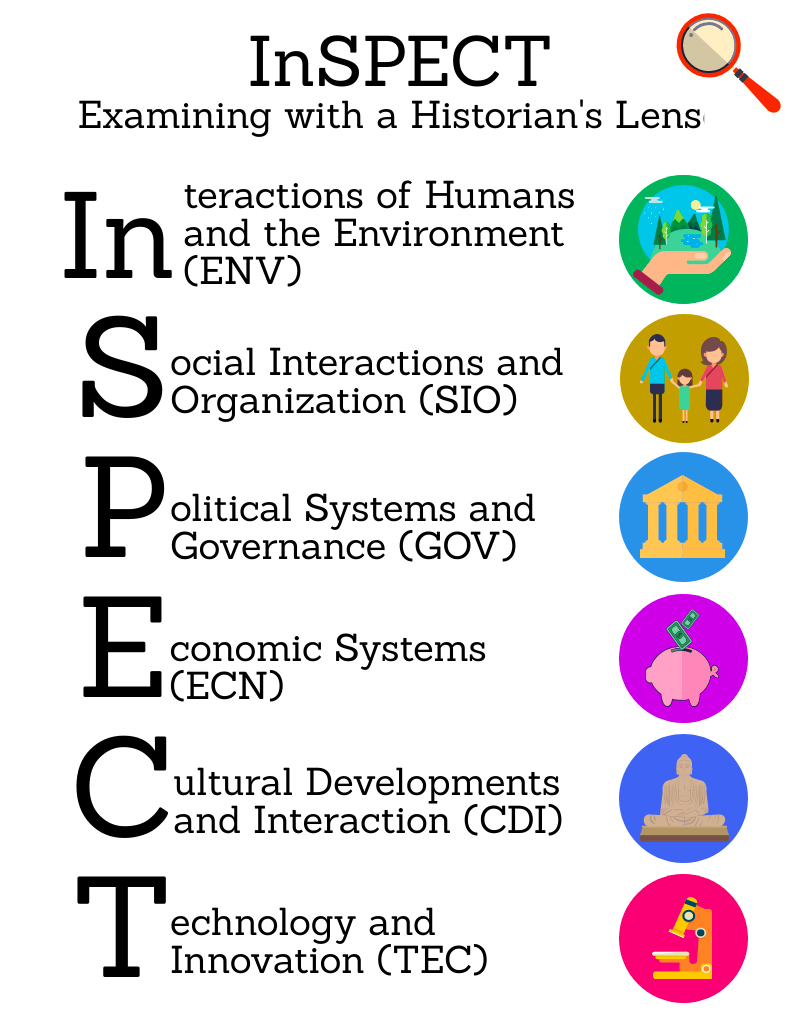
CollegeBoard organizes APWH around six themes. Topic pages tag every claim to the relevant themes — useful when you’re studying for the LEQ.
1.Humans & the Environment
How geography, climate, and disease shape human life — and how humans push back.
ENV
ENV
Geography, climate, and disease set the stage and rewrite the script. The CED expects you to trace how the environment shapes human institutions — and how human institutions reshape the environment back, with consequences nobody planned.
- Unit 1 — Song China — Champa rice (from Vietnam) doubles rice yields and powers China’s first urban revolution.
- Unit 2 — Mongol disease network — The Black Death moves along Mongol-secured trade routes — a trade network becomes a disease network.
- Unit 4 — Columbian Exchange — Smallpox kills ~90% of indigenous populations; American crops remake European diets and demographics.
- Unit 6 — Coal & climate — Industrial coal extraction launches the 200-year experiment that produced today’s atmospheric CO₂.
2.Cultural Developments & Interactions
Religions, philosophies, art, and the cross-pollination that happens when worlds meet.
CDI
CDI
Religions, philosophies, art, and science cross-pollinate when worlds meet. CDI questions ask how ideas spread, how they change in transit, and how local cultures contest or transform them.
- Unit 1 — Sufism — Sufi missionaries spread Islam into Central Asia, India, and West Africa by adapting to local cultures.
- Unit 3 — Mughal religious synthesis — Akbar invites Hindu, Jain, Christian, and Zoroastrian scholars to his court and proclaims a syncretic faith (Din-i-Ilahi).
- Unit 5 — Atlantic ideas — Enlightenment concepts of consent and rights cross the Atlantic and power revolutions in the U.S., France, and Haiti.
- Unit 9 — Globalization — K-pop, Bollywood, and Premier League football show cultural production no longer flowing only from West to rest.
3.Governance
Empires, states, and the strategies they use to legitimize and sustain themselves.
GOV
GOV
Empires, states, and the strategies they use to legitimize and sustain themselves. GOV asks: who has authority, where does it come from, and how is it enforced?
- Unit 1 — Song bureaucracy — China runs the world’s largest empire through a meritocratic civil service exam — for centuries before Europe.
- Unit 3 — Gunpowder empires — Ottoman Janissaries (devshirme) build a slave-soldier elite loyal only to the Sultan, bypassing rival aristocracy.
- Unit 5 — Nation-state — The French Revolution invents the modern idea of citizens, not subjects — popular sovereignty as state legitimacy.
- Unit 7 — Totalitarianism — Soviet, Nazi, and fascist states show what 20th-century mass media + bureaucracy can do to scale up control.
- Unit 9 — Supranational — UN, EU, WTO, IMF — partial sovereignty pooled at the international level for problems no single state can solve alone.
4.Economic Systems
Trade networks, labor systems, and the rise (and limits) of global capitalism.
ECN
ECN
Trade networks, labor systems, and the rise (and limits) of capitalism. ECN traces the economic structures that shape everything else — politics, demographics, family life.
- Unit 2 — Indian Ocean — Monsoon winds + dhows organize 1,500 years of maritime trade linking East Africa, India, Southeast Asia, China.
- Unit 4 — Atlantic system — The triangular trade integrates three continents into one economy — built on ~12.5 million enslaved Africans.
- Unit 6 — Industrial capitalism — Factories, wage labor, and joint-stock corporations replace guild and household production.
- Unit 9 — Globalization — Container shipping + WTO rules + Chinese manufacturing build the global supply chain economy after 1980.
5.Social Interactions & Organization
Family, gender, class, ethnicity — and how power is distributed (or contested) along those lines.
SIO
SIO
Family, gender, class, ethnicity — and how power is distributed (or contested) along those lines. SIO is how you analyze who wins and who loses inside a society, not just between societies.
- Unit 1 — Foot binding — Song-era foot binding signals elite female status while physically constraining women’s labor and mobility.
- Unit 4 — Casta system — Spanish America’s casta hierarchy ranks people by ancestry — the racial pyramid the Atlantic world inherits.
- Unit 5 — French Revolution & class — The Third Estate (~98% of France) overthrows the privileged First and Second Estates — modern class politics begin.
- Unit 9 — Identity movements — Civil rights, women’s lib, decolonization, LGBTQ+ rights — 20th-century movements rewriting who counts as a full citizen.
6.Technology & Innovation
From gunpowder and steam to the internet — and the unforeseen consequences each time.
TEC
TEC
From gunpowder and steam to the internet — and the unforeseen consequences each time. TEC asks how invention reshapes power, labor, war, and daily life.
- Unit 1 — Song innovations — Gunpowder, movable type, paper money, magnetic compass — all emerge in Song China and slowly diffuse west.
- Unit 4 — Caravels & navigation — Lateen sail + astrolabe + magnetic compass let Iberians cross the Atlantic — and conquer two continents.
- Unit 6 — Steam power — The steam engine moves textile factories from waterwheels — and powers railroads, ships, and the Industrial Revolution.
- Unit 7 — Industrial war — Machine guns, tanks, aircraft, and chemical weapons turn WWI into the first industrial-scale slaughter.
- Unit 9 — Internet — Networked computers + smartphones rewire commerce, politics, and information — with consequences still unfolding.
Digital exam — and a new free-response format.
AP World History: Modern is now a fully digital exam, taken in College Board’s Bluebook app: multiple-choice on screen, every free-response answer typed, and everything submitted automatically at the end.
And starting with the May 2027 exam, the free-response section changes:
- ▸ SAQ — three questions, all required — the old “answer two, then choose Q3 or Q4” is gone. One gives you a secondary source, one a primary source, and one a non-text source like a map or chart, each from a different era.
- ▸ LEQ — one essay, required — no more choosing one of three — now with a short prompt to orient you to the task.
- ▸ DBQ — still seven documents, now drawing on a wider span of the course.
Unchanged: the scoring rubrics, the course content, and the multiple-choice section. What’s new is that you type — and the written section no longer makes you choose.
Four skills, in order of pain.
Each skill has a rubric, an annotated exemplar, a “common mistakes” callout, and a writeable practice prompt that hands off to the AP Tutor for feedback.
Stimulus MCQ
How to read a passage like a historian, fast.
SAQ
Three quick parts. The art of saying enough — and no more.
LEQ
One big argument, three paragraphs, all the evidence you can muster.
DBQ
Seven documents, a thesis, contextualization, and the patience to do all of it under time.